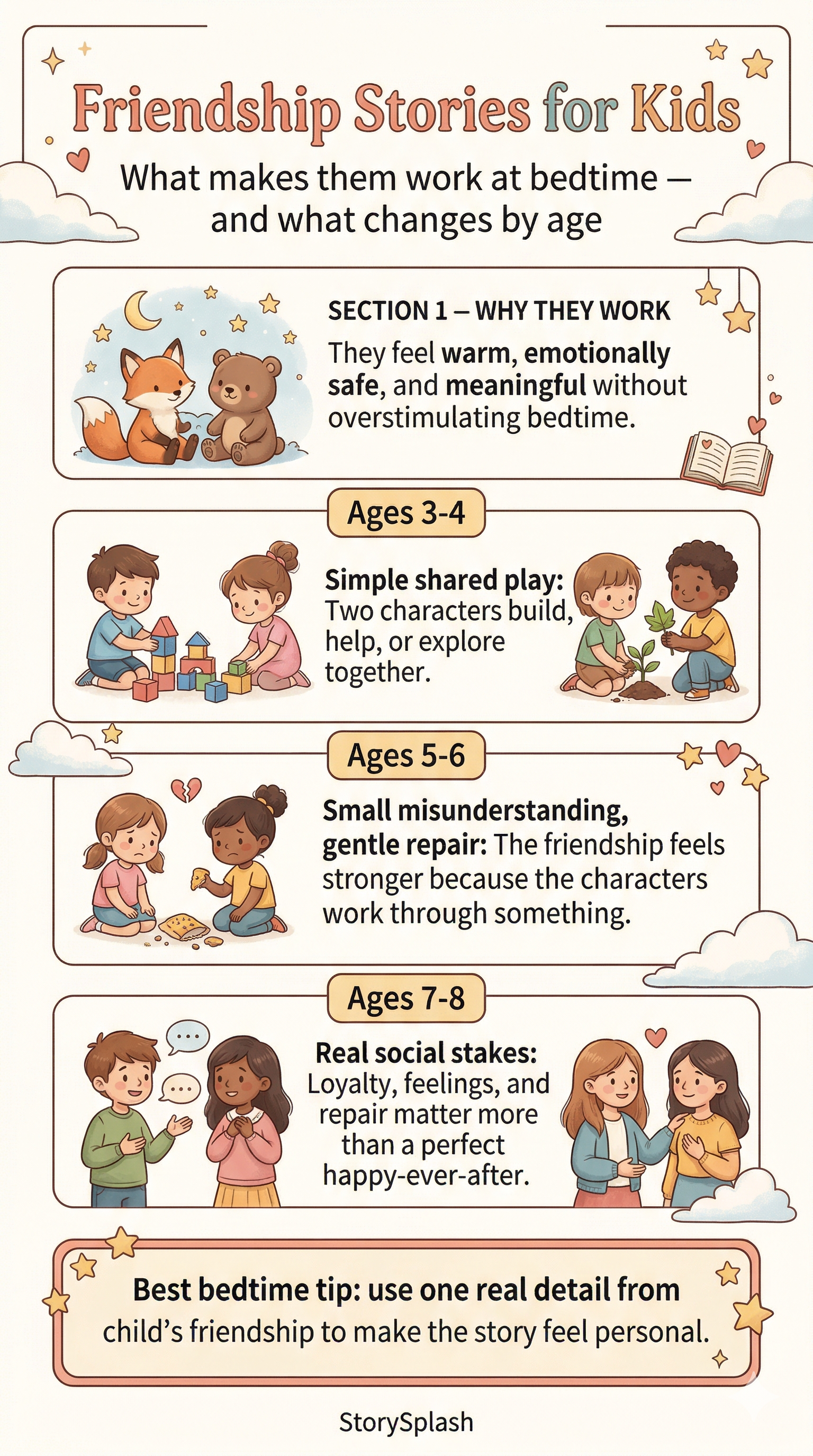
Friendship is one of the safest, warmest story themes you can bring into bedtime. It gives children something emotionally interesting to follow without the intensity of a scary adventure or the overstimulation of a cliffhanger. The friendship stories kids ask for again are usually the ones where the relationship feels real.
Why Friendship Stories Work So Well at Night
Children process social life through story more easily than through direct advice. A lecture about being kind or including others usually gets a polite nod. A story about two children who misunderstand each other, work it out, and end the night closer than before does more lasting work.
That is part of why friendship stories fit bedtime so naturally. They are emotionally meaningful without being sharp or activating. The child gets to follow a connection being built, repaired, or deepened, and the story ends with the comfort of belonging.
Practical tip: If your child is having a hard week with school friendships, choose a friendship story that loosely echoes the feeling rather than copying the exact situation.
What Friendship Stories Look Like at Different Ages
At ages 3-4, friendship stories work best when they are simple and concrete. Two characters build something together, help each other, or solve a small problem side by side. The emotional lesson is in the shared experience, not the dialogue.
At ages 5-6, children are ready for a misunderstanding in the middle. One friend gets left out, one makes the wrong assumption, one feels hurt, and the repair matters more than the problem itself.
By ages 7-8, the strongest friendship stories reflect real social pressure. A third character changes the dynamic. A choice has to be made. The story feels true because the friendship is tested and then rebuilt.
Practical tip: For older children, the most satisfying ending is not “they stayed best friends forever.” It is showing what a real apology and repair actually look like.
Stories About Making Friends
Some friendship stories are about a relationship that already exists. Making-friends stories are slightly different. The child is standing at the edge of a new group, new classroom, new playground, or new activity, and the question is: how do I begin?
That is a useful story shape for children who want friends but freeze at the first step. The hero does not need to become suddenly bold. They can notice one shared interest, ask one small question, or join one simple game.
For school transitions, this pairs naturally with first day of school stories. For children who are learning to make room for someone else, stories about sharing for kids can support the same social skill from another angle.
Practical tip: Give the hero a very small opening line, like “Can I help?” or “Do you need this blue block?” Children remember usable phrases better than general advice.
The Details That Make a Friendship Story Feel Real
Specificity matters more than plot. A child will remember two friends who always collect shiny stones together or who argue over who gets to hold the flashlight. They will not remember two generic “best friends” who are simply kind all the time.
The same is true for dialogue. Friendship stories land when the characters sound like actual children, not tiny adults explaining values to each other. A little messiness makes the relationship believable.
If you already know your child loves other story themes, this is a good place to blend them. A friendship story can easily overlap with space stories for kids or adventure stories for kids while still keeping the emotional center on the relationship.
Practical tip: Before you start, ask your child what they and their best friend always do together. One real detail makes the whole story feel personal.
A Sample Story You Can Read Tonight
Noah and the Blue Block
Noah’s new classroom had a rug with roads on it, a shelf full of picture books, and a block corner that looked like a tiny city waiting to happen.
Noah liked blocks.
He liked square blocks, bridge blocks, triangle roof blocks, and the long flat blocks that made excellent roads.
But on his first morning, three children were already building in the block corner.
One child stacked towers. One child made a wall. One child drove a wooden car along the edge of the rug.
Noah stood nearby, holding his backpack strap.
He wanted to build too.
He did not know what to say.
His teacher, Ms. Lane, came beside him. “You are watching carefully,” she said.
Noah nodded.
“Sometimes watching helps us find a place to begin.”
Noah watched. The tower child picked up a red block, then looked around.
“I need a blue one,” she said.
Noah saw a blue block near his shoe. It was smooth and square and exactly the right size.
His hand wanted to pick it up. His voice wanted to hide.
Ms. Lane did not push him. She only whispered, “One small sentence can be enough.”
Noah picked up the block.
His heart beat fast, but his feet walked two steps forward.
“Do you need this blue block?” he asked.
The tower child turned around. “Yes! Thank you. It is for the sky floor.”
Noah had never heard of a sky floor.
“What is a sky floor?” he asked.
“It is where the birds park,” said the child.
That was such a good answer that Noah forgot to feel shy for one second.
“Birds do not park,” he said.
“These birds do,” she said. “They have tiny scooters.”
Noah smiled.
“I can make a scooter road,” he said.
The child moved over to make space. “I am Amara.”
“I am Noah.”
Noah chose two long flat blocks and placed them end to end. The wooden car child drove over immediately.
“That road needs a bridge,” he said.
Noah found an arch block. “Like this?”
“Yes,” said the boy. “I am Ben.”
Soon the tiny city had a sky floor, a scooter road, a bridge, and a garage for birds who needed snacks.
Noah still felt shy when he talked. But the shyness was smaller now because his hands were busy building.
At cleanup time, Amara said, “Tomorrow we can make the bird elevator.”
Noah looked at Ms. Lane.
She smiled like she had seen the whole thing.
On the way home, Dad asked, “How was your first day?”
Noah thought about the moment before he spoke, when the blue block had felt heavy in his hand.
“I gave someone a block,” he said.
“That sounds helpful.”
“Then we made a sky floor.”
Dad blinked. “Of course.”
That night, Noah built a tiny city beside his bed with three blocks: one blue square, one long road, and one arch bridge.
He was still a little nervous about tomorrow.
But now he knew one way to begin.
Sometimes a friend starts with a big hello.
And sometimes a friend starts with one blue block.
How to Make a Making-Friends Story Personal
Use the real setting where your child is practicing friendship: preschool, kindergarten, playground, soccer, dance, or a cousin’s house. Then give the hero one small social action they can actually use.
If your child wants to choose the setting or the kind of friend in the story, the story idea quiz can help turn that into a bedtime-ready prompt.
When the Story Feels Like Your Child’s Own
Friendship stories become even stronger when your child recognizes themselves in the center of the story. A named hero who is shy at first, curious in the middle, and proud by the end creates a very different kind of attention from a generic character doing the same things.
That is why StorySplash’s friendship stories work well at bedtime. The child is not just hearing about a friendship. They are stepping into one, with a world and tone that match what they are ready for that night.
Practical tip: If your child wants the same friendship story theme night after night, keep the emotional shape and change the setting. Familiar feeling, new details.
Don’t have time to tell this story tonight? StorySplash generates it for you in 30 seconds.