Seven-year-olds are rarely chaotic about bedtime in the way toddlers are. They are strategic. They know how time works. They remember past exceptions. They can build a surprisingly good case for why tonight should be different. The routine that works at this age is not harsher. It is clearer.
Why Seven-Year-Olds Resist Bedtime Differently
By seven, children are practicing independence all day long. They want to choose, explain, negotiate, and influence what happens next. When bedtime feels like a sudden wall instead of a sequence they understand, they push back with all of those new skills.
That is why a vague bedtime routine tends to fail at this age. A routine that lives only in the parent’s head is easy to argue with. A routine that is short, visible, and repeated in the same order each night is much harder to challenge.
Practical tip: Explain the routine in the afternoon or on the weekend, not in the middle of a difficult bedtime.
A 22-Minute Bedtime Routine That Holds on School Nights
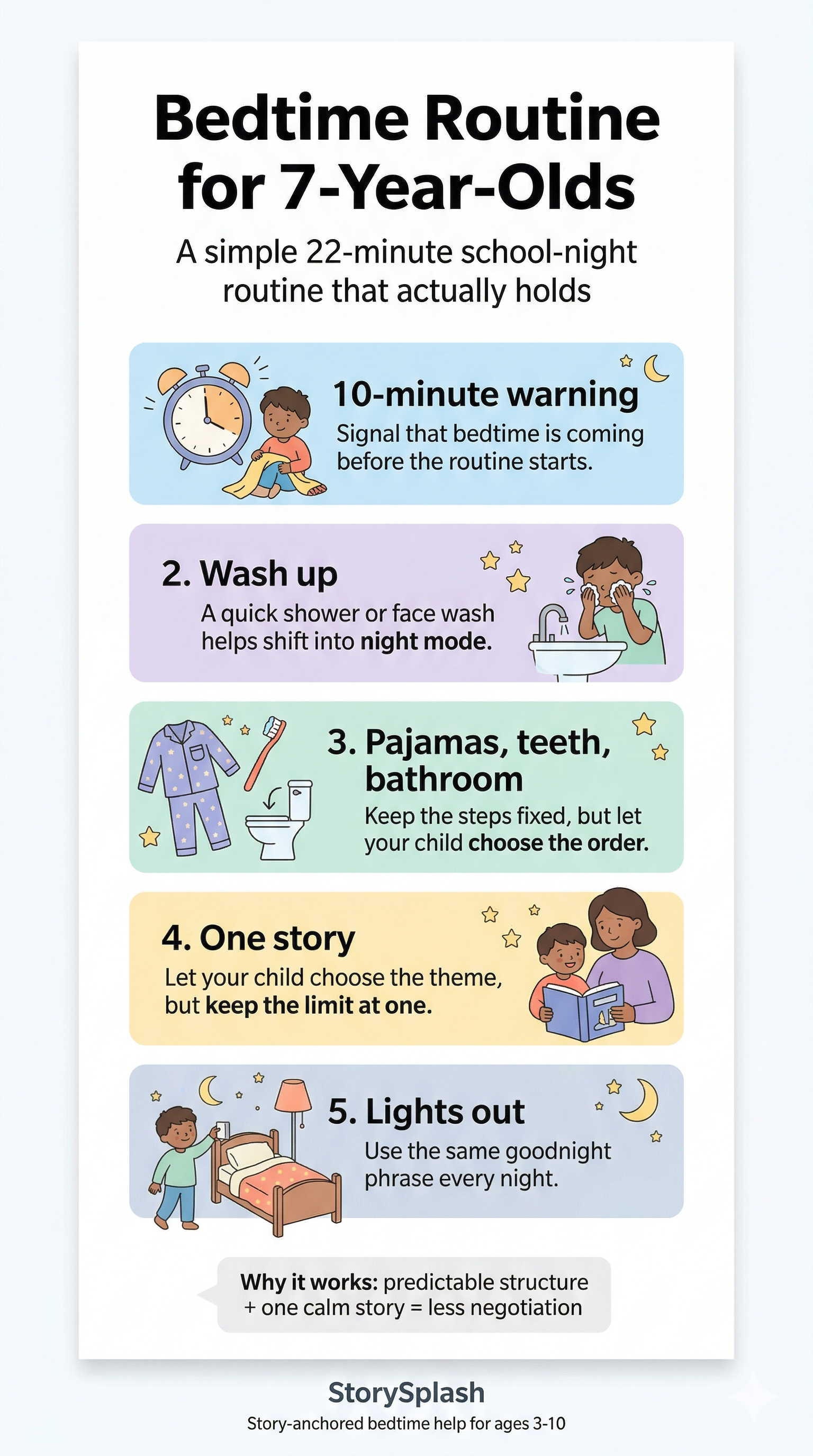
Here is a structure that works well for many seven-year-olds because it gives them one or two real choices without giving away the shape of the night.
| Step | What to do | Target time |
|---|---|---|
| 1 | 10-minute warning | Before starting |
| 2 | Shower or wash face | 5 minutes |
| 3 | Pajamas, teeth, bathroom | 7 minutes |
| 4 | One story — child picks the theme | 8 minutes |
| 5 | Goodnight phrase, lights out | 2 minutes |
The important part is not perfection. It is predictability. When your child knows the shape of bedtime, they spend less energy testing it.
Practical tip: Put the routine where your child can see it. Pointing to the plan works better than repeating it out loud every night.
The Story Step Is the Anchor, Not the Reward
At seven, stories are doing real wind-down work. Children this age can hold a plot in their head, imagine the world vividly, and stay with the character all the way to the resolution. That mental settling is often the most calming part of the routine.
This is why it helps to treat the story as a fixed step instead of a reward that can be taken away. Removing the story does not usually make bedtime easier. It removes the strongest part of the transition.
If your child liked the pattern in bedtime routine for 6-year-olds, this next step is mostly about keeping the structure while giving them slightly more voice inside it.
Practical tip: Let your child choose the story theme, not the number of stories. Choice over flavor, limit over length.
The Stall Tactics That Show Up Most at Seven
At this age, the stalls are familiar. “I am not tired.” “What about last Thursday?” “I need water.” “Can I read one more thing?” The answer is not a new argument for every version. The answer is building the likely detours into the routine before they show up.
Water goes by the bed before the story. Bathroom happens before the story. The same goodnight phrase happens after the story. The more you reduce live decision-making, the less room there is for negotiation.
Practical tip: When your child says they are not tired, answer the routine, not the feeling: “You do not have to be sleepy yet. It is quiet time now.”
StorySplash helps here because the story step stays easy even on rushed nights. Parents can generate a personalized illustrated story in about two minutes, keep the calm ending intact, and avoid turning bedtime into one more moment where they have to improvise under pressure.